Archive for July, 2026

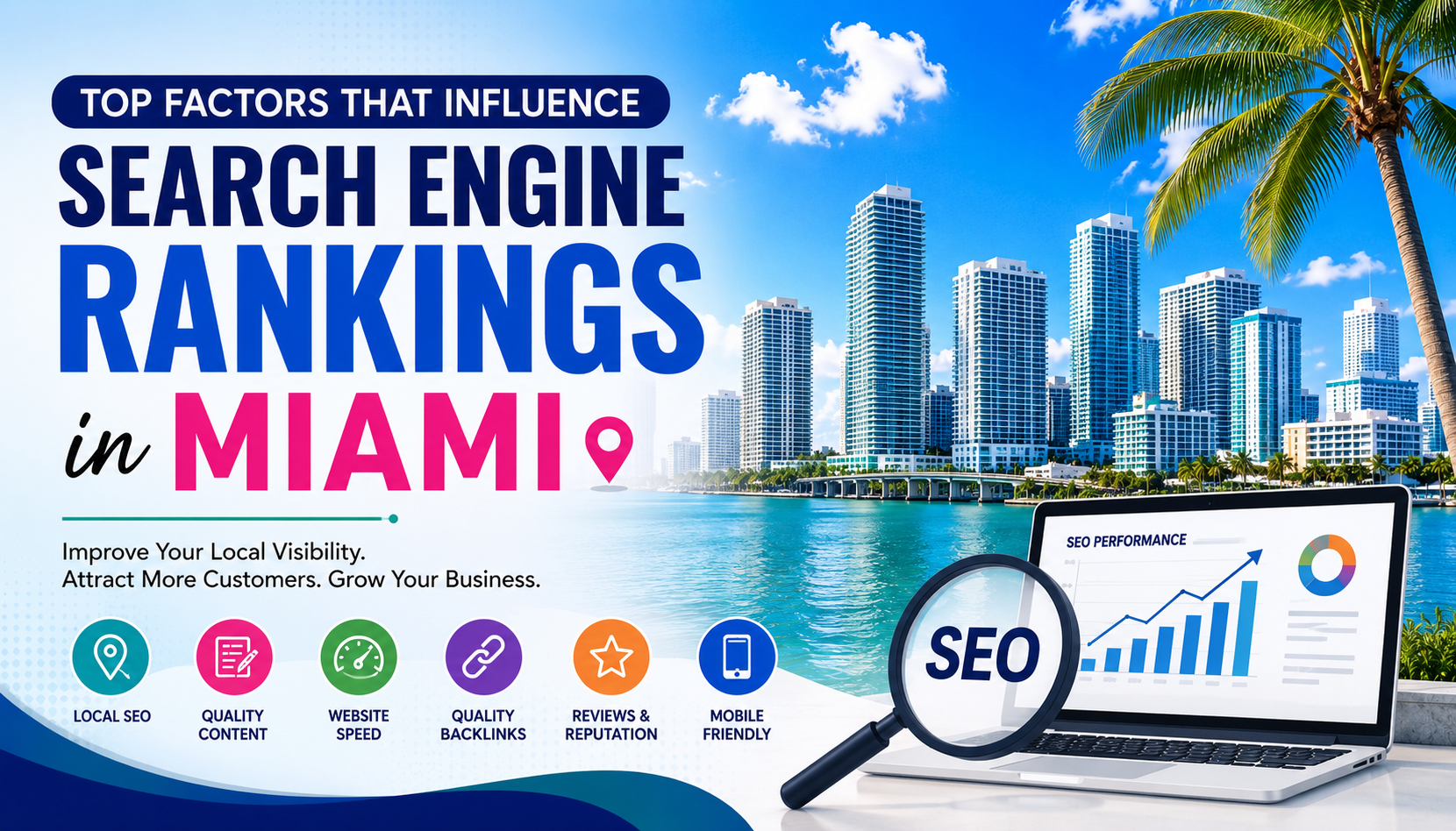
Top Factors That Influence Search Engine Rankings in Miami

Saturday, July 18th, 2026

Top Factors That Influence Search Engine Rankings in Miami

If you’re a business owner in Miami, having a website is only the first step toward building an online presence. To attract local customers and stay ahead of the competition, your website needs to rank well on Google. With thousands of businesses competing for visibility, understanding the factors that influence search engine rankings is essential.

In this guide, we’ll explore the key SEO factors that can help your website achieve higher rankings in Miami and drive more local traffic.

1. Optimize for Local SEO

Local SEO is one of the most important ranking factors for businesses targeting customers in Miami. Search engines prioritize businesses that are relevant to a user’s location.

To improve your local rankings:

Claim and optimize your Google Business Profile.
Use consistent Name, Address, and Phone Number (NAP) information across all directories.
Include location-specific keywords like “Miami SEO Services” or “Web Design in Miami.”
Encourage satisfied customers to leave Google reviews.

2. Publish High-Quality, Localized Content

Content remains one of Google’s strongest ranking signals. Creating valuable, informative, and location-focused content helps establish your authority and relevance.

Ideas for localized content include:

  • Miami business guides
  • Local industry trends
  • Event-related blog posts
  • Customer success stories
  • Frequently asked questions from Miami customers

Fresh, informative content encourages visitors to stay longer on your website and increases your chances of ranking higher.

3. Ensure Your Website Is Mobile-Friendly

Most local searches happen on smartphones. Google uses mobile-first indexing, meaning it primarily evaluates the mobile version of your website.

A mobile-friendly website should:

  • Load quickly
  • Display properly on all screen sizes
  • Have easy-to-read text
  • Feature simple navigation
  • Include clickable buttons and contact information

A positive mobile experience improves both rankings and conversions.

4. Improve Website Speed

Page speed is a confirmed ranking factor. Slow-loading websites often experience higher bounce rates and lower user engagement.

To improve website speed:

  • Compress images
  • Enable browser caching
  • Minimize CSS and JavaScript files
  • Use a Content Delivery Network (CDN)
  • Choose reliable web hosting

Fast websites create a better user experience and are favored by search engines.

5. Optimize On-Page SEO

Every page on your website should be optimized for relevant keywords without overusing them.

Key on-page SEO elements include:

  • SEO-friendly page titles
  • Compelling meta descriptions
  • Proper heading structure (H1, H2, H3)
  • Image alt text
  • Internal linking
  • Clean, descriptive URLs

These elements help search engines understand your content and improve your visibility.

6. Build High-Quality Backlinks

Backlinks from reputable websites act as votes of confidence for your site. The more high-quality backlinks you earn, the more trustworthy your website appears to Google.

Effective ways to build backlinks include:

  • Guest blogging
  • Local business partnerships
  • Directory listings
  • Press releases
  • Publishing valuable resources others want to reference

Focus on quality over quantity when building links.

7. Maintain a Strong Online Reputation

Customer reviews influence both local rankings and consumer trust. Positive reviews signal credibility and reliability.

Encourage customers to:

Leave Google reviews
Share feedback on trusted review platforms
Rate your services honestly

Responding professionally to reviews—both positive and negative—demonstrates strong customer service.

8. Focus on User Experience (UX)

Google rewards websites that provide a positive experience for visitors.

Improve your user experience by:

  • Making navigation intuitive
  • Reducing intrusive pop-ups
  • Using clear calls-to-action
  • Organizing content for readability
  • Ensuring all pages function properly

A seamless browsing experience keeps users engaged and supports better rankings.

9. Use Structured Data (Schema Markup)

Schema markup helps search engines understand your content more effectively and can enhance your search listings with rich results.

Businesses can use schema to display:

  • Business information
  • Reviews
  • FAQs
  • Services
  • Contact details

These enhanced search results can improve click-through rates and visibility.

10. Keep Your Website Updated

SEO is an ongoing process. Regularly updating your website with fresh content, new service pages, and technical improvements signals that your site remains active and relevant.

Review your website periodically to:

  • Fix broken links
  • Update outdated content
  • Improve page performance
  • Add new blog posts
  • Monitor keyword performance

Consistent optimization helps maintain and improve your search rankings over time.

Final Thoughts

Achieving higher search engine rankings in Miami requires more than simply adding keywords to your website. Success comes from combining strong local SEO, valuable content, technical optimization, quality backlinks, and an excellent user experience.

By consistently improving these areas, your business can increase its online visibility, attract more qualified local customers, and build long-term success in Miami’s competitive digital landscape.

Need help improving your website’s rankings in Miami? Partner with an experienced SEO team to develop a customized strategy that drives sustainable growth and delivers measurable results.
The Ultimate Website Owner’s Guide to the Google May 2026 Core Update

Wednesday, July 1st, 2026

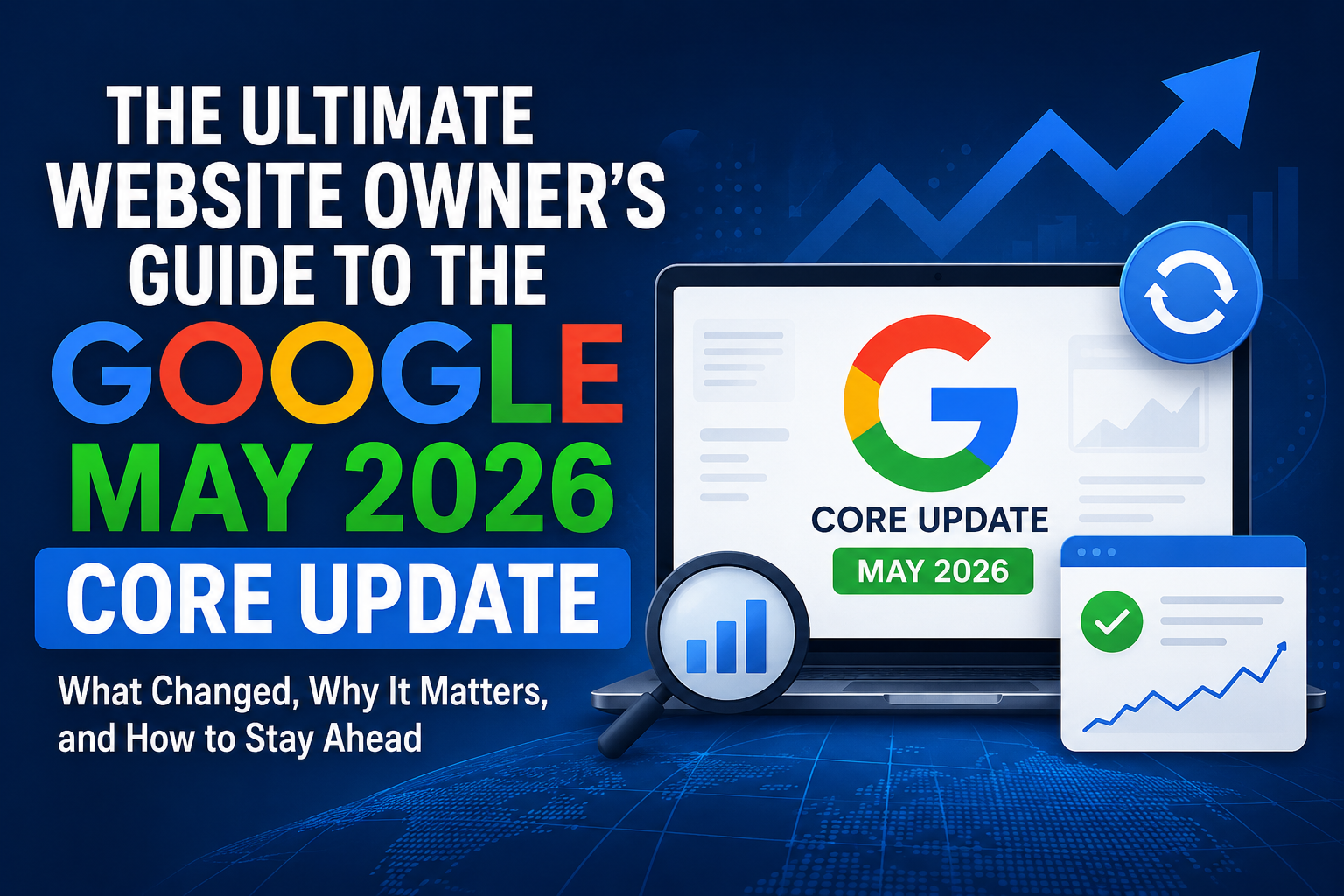
Google’s May 2026 Core Update is one of the most significant algorithm updates of the year. Officially launched on May 21, 2026, the rollout lasted nearly 12 days, completing on June 2, 2026. Like previous broad core updates, its primary goal was to improve search quality by surfacing the most relevant, helpful, and trustworthy content across the web.

For many website owners, the update resulted in noticeable ranking fluctuations, traffic changes, and shifts in keyword visibility. If your website experienced gains—or losses—this guide explains what changed, why it matters, and what you should do next.

What Is the Google May 2026 Core Update?

A Google Core Update is a broad improvement to Google’s ranking systems. Unlike spam updates or manual penalties, core updates are not designed to punish specific websites.

Instead, Google recalibrates how it evaluates content quality, relevance, authority, and user satisfaction. As a result:

Some websites gain visibility.

Others lose rankings.

Many sites experience temporary fluctuations during the rollout.

Google described the May 2026 update as a regular core update designed to better surface relevant and satisfying content for searchers across all types of websites.

Timeline of the May 2026 Core Update

Event Date Rollout Started May 21, 2026 Estimated Duration About 2 weeks Rollout Completed June 2, 2026 Total Rollout Time Approximately 12 days

This became the second major core update of 2026, following the March Core Update.

Why Did Google Release This Update?

Google continuously improves Search to ensure users receive:

  • More accurate answers
  • More useful content
  • Better expert information
  • Fewer low-value pages
  • Higher-quality user experiences

The May update arrived shortly after Google I/O 2026, where Google announced major AI-driven improvements to Search. While Google has not confirmed a direct connection between the core update and these AI changes, many SEO professionals believe the timing reflects Google’s broader effort to improve search quality in an AI-powered Search environment.

Who Was Most Affected?

The update impacted websites across nearly every industry, including:

  • Blogs
  • News websites
  • E-commerce stores
  • SaaS businesses
  • Local businesses
  • Educational websites
  • Healthcare websites
  • Finance websites

No single niche was specifically targeted.

Instead, Google reassessed content quality across all industries.

Common Ranking Changes Website Owners Observed

Many SEO tracking tools reported significant volatility throughout the rollout. Common observations included:

Increased Ranking Volatility

Keywords moved significantly over several days before stabilizing.

Traffic Gains

Websites with strong topical authority, comprehensive content, and established trust often saw increased visibility.

Traffic Drops

Sites relying on thin, outdated, repetitive, or heavily scaled content experienced declines.

AI Overview Changes

Some publishers also reported changes in how their pages appeared within AI-powered Search features, although Google did not provide specific details linking these changes to the core update.

Signs Your Website Was Impacted

Check Google Search Console for:

  • Sudden drops in impressions
  • Lower organic clicks
  • Ranking declines across multiple pages
  • Keyword position changes
  • Reduced visibility for previously high-performing pages

Remember that temporary fluctuations during a rollout are normal. Google advises waiting until the rollout has fully completed before evaluating performance.

What Google Recommends

Google has consistently advised website owners not to make immediate changes while a core update is still rolling out.

Instead:

Wait until rankings stabilize.
Compare performance before and after the update.
Identify pages with sustained declines.
Focus on improving content quality rather than looking for technical “fixes.”

How to Recover After the May 2026 Core Update

1. Improve Content Quality

Ask yourself:

Does this page answer the user’s question completely?
Is the information current?
Is the content original?
Does it provide unique insights?

Avoid publishing content that simply repeats what’s already available elsewhere.

2. Strengthen Topical Authority

Rather than publishing hundreds of unrelated articles, build expertise around your core subject.

For example:

Instead of writing about everything in digital marketing, focus on one area such as:

SEO
Content Marketing
Local SEO
Technical SEO

Create interconnected content clusters that comprehensively cover the topic.

3. Demonstrate Experience and Expertise

Google increasingly rewards content that reflects real-world knowledge.

Ways to improve include:

Original screenshots
Case studies
Personal testing
Expert commentary
First-hand experiences
Research-backed insights

4. Refresh Older Content

Update articles by:

Removing outdated information
Adding recent statistics
Expanding thin sections
Improving readability
Fixing broken links
Updating images

Freshness alone isn’t a ranking factor, but maintaining accurate, useful content improves user satisfaction.

5. Improve User Experience

Core Web Vitals remain important.

Review:

Page speed
Mobile usability
Layout stability
Navigation
Readability
Internal linking

A good user experience helps visitors engage with your content.

6. Build Trust

Google values websites that demonstrate credibility.

Include:

Author bios
Contact information
Editorial policies
About page
HTTPS security
Clear sourcing for factual claims

These elements help users and search engines assess your site’s trustworthiness.

7. Avoid Shortcuts

The May 2026 update reinforces Google’s long-term direction.

Avoid:

Keyword stuffing
Thin AI-generated pages
Duplicate content
Mass-produced articles without editorial review
Manipulative link-building schemes

Google continues to emphasize content that is genuinely useful to people.

Should You Delete Low-Performing Pages?

Not necessarily.

Before deleting content:

Improve it.
Merge overlapping articles.
Add unique value.
Update outdated information.

Delete pages only if they are truly obsolete or provide no value.

SEO Checklist After the May 2026 Core Update

✅ Review Google Search Console data

✅ Compare traffic before and after June 2

✅ Update outdated content

✅ Improve internal linking

✅ Enhance author expertise

✅ Remove duplicate content

✅ Improve page speed

✅ Add original visuals and examples

✅ Strengthen topic clusters

✅ Continue publishing high-quality content consistently

Frequently Asked Questions
Was this a penalty update?

No. Core updates are not penalties. They reassess how Google’s systems rank content across the web.

How long did the rollout last?

The rollout started on May 21, 2026, and completed on June 2, 2026, lasting nearly 12 days.

Should I make immediate SEO changes after a ranking drop?

It’s better to wait until the rollout has completed and then evaluate trends using Google Search Console.

Does Google target AI-generated content?

Google focuses on content quality rather than how it is produced. However, low-value, unhelpful, or mass-produced content—whether AI-generated or not—is less likely to perform well. Recent policy updates also explicitly address attempts to manipulate AI-powered search systems.

Final Thoughts

The Google May 2026 Core Update reinforces a familiar message: websites that prioritize helpful, original, and trustworthy content are better positioned for long-term success. While ranking fluctuations can be frustrating, broad core updates are an opportunity to assess your content objectively and improve it for real users—not just search engines.

Rather than chasing algorithm changes, invest in creating content that demonstrates expertise, answers users’ questions comprehensively, and offers genuine value. Over time, that strategy is the most resilient approach to succeeding in Google Search.